A very thin gruel, indeed
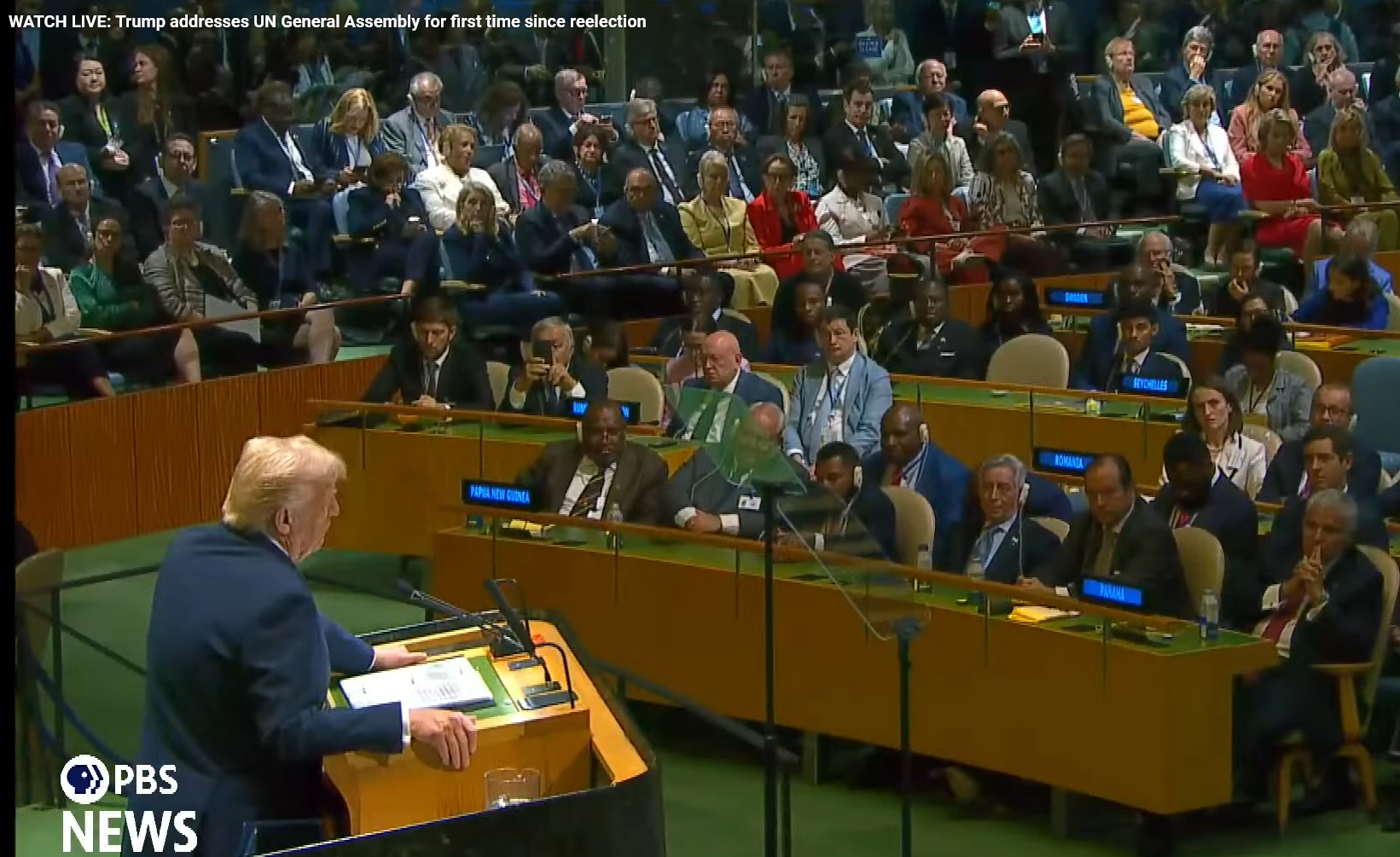
On 23 September, President Donald Trump addressed the UN General Assembly (UNGA). In an unexpected move, he called on the world’s nations to halt the development of biological weapons (BW). Referring to the COVID pandemic five years earlier and reckless laboratory experiments, he announced a US-led international effort to strengthen the Biological and Toxin Weapons Convention (BTWC), and proposed an artificial intelligence (AI)-driven verification system.
After more than two decades of opposition, his speech seemed to indicate that Washington might embrace verification machinery for the BTWC. However, the less than two minutes he devoted to the topic contained little substance and left people wondering. The White House did not release a document outlining the plan behind the vision. Neither did the State Department.
Some institutions and authors embraced the AI reference, expressed caution, and offered broad outlines of how AI might support verification or assist with the submission and analysis of BTWC-related confidence-building measures (CBMs). (For example, in chronological order: NTI, James Revill, Glenn Cross, and Lucas Fluegel.)
Personally, I was sceptical. If the proposed initiative were real, I would have expected concept notes, a working paper for the BTWC Working Group session or the Meeting of State Parties (MSP) scheduled for December, or a statement by a – any – government official elaborating the thinking. Still, I waited to publicly comment on President Trump’s UN address until the BTWC meetings last month. In the past, high-ranking officials had travelled from Washington to Geneva to publicise new initiatives or update the delegates on US positions.
So, on 15 December, the only day the MSP met (as Russia had blocked the adoption of the agenda), the US delegation held a lunchtime side event during which Under Secretary of State for Arms Control and International Security Thomas DiNanno, accompanied by representatives of the Departments of War, Health and Human Services and Energy, elaborated on the President’s initiative.
After the side event, I could not help but think about the scene in which Oliver Twist, holding up an empty basin and spoon, approached the headmaster standing next to the copper with gruel and asked: ‘Please, sir, I want some more.’
The UNGA statement
As far as I can ascertain, no official document containing President Trump’s prepared remarks is available on the White House, State Department, or US Mission to the UN websites. The US Public Broadcasting Service offers a live video recording and transcript of the speech. Both records include Trump’s unscripted digressions. Some policy comments may, therefore, lack inter-agency endorsement. So, when assessing the significance of the BTWC verification passage, the proposal’s contextual backdrop – its place in the address, Trump’s tone and cadence, and his body language – gains importance.
Just over a third into his 58-minute speech to the UNGA, Trump addressed biological threats and suggested groundbreaking AI-assisted verification in a US-led international effort to enforce the BTWC:
As we seek to reduce the threat of dangerous weapons today. I’m also calling on every nation to join us in ending the development of biological weapons once and for all, and biological is terrible and nuclear is even beyond, and we include nuclear in that. We want to have a cessation of the development of nuclear weapons. We know and I know and I get to view it all the time, “Sir, would you like to see?” And I look at weapons that are so powerful that we just can’t ever use them. If we ever use them, the world literally might come to an end. There would be no United Nations to be talking about. There would be no nothing. Just a few years ago, reckless experiments overseas gave us a devastating global pandemic, yet despite that worldwide catastrophe, many countries are continuing extremely risky research into bio-weapons and man-made pathogens. This is unbelievably dangerous. To prevent potential disasters I’m announcing today that my administration will lead a international effort to enforce biological weapons convention, which is going to be meeting with the top leaders of the world by pioneering an AI verification system that everyone can trust. Hopefully the UN can play a constructive role and it will also go, be one of the early projects under AI. Let’s see how good it is because a lot of people saying it could be one of the great things ever, but it also can be dangerous, but it could be put to tremendous use and tremendous good, and this would be an example of that.
The highlighted passages clearly mark Trump’s off-the-cuff interjections. The syntax becomes simpler, the tone shifts to an informal one, and the phrasing is less precise. After raising the idea of AI-supported verification, he ruminated on the benefits and dangers without clarifying whether his many uses of ‘it’ referred to the AI verification system or just to AI. Given the President’s preoccupation with AI innovation and infrastructure, it may well have been the latter.
The contrast with the scripted message is the highest at the start of the BW-related message. The segment follows an ad-libbed rebuke of European countries buying Russian oil. Without pausing, Trump’s return to the prepared text was evident: he read at a brisk pace, if in a monotonous voice, from the teleprompter; the phraseology was more complex, and his posture behind the microphone and body language shifted. The same was true after the aside on the destructiveness of nuclear weapons. We may therefore assume that these scripted parts are policy elements endorsed by the entire administration.
Even so, the prepared remarks on an AI-assisted BTWC verification system lacked detail. Which verification system does the current US administration have in mind? And, how does it envisage the potential contribution of AI? The scripted text revealed some of the motivation behind the proposal. The reference to the recent pandemic and its association with risky (read: gain-of-function) research alluded to the laboratory-origin theory of COVID-19. Such activities could contribute to BW development or again result in human-made pandemics.
In this respect, it is interesting to note that Trump did not riff on the BTWC, enforcement or verification, suggesting less familiarity with those matters. Rumour in Geneva has it that Robert Kennedy Jr., Secretary of Health and Human Services (HHS), pressed quite late in the drafting process for the inclusion in the UN address. If confirmed, his intervention would explain not just the angle taken in the speech, but also the lack of background papers and the awkward placement of the idea between a complaint about China and India buying Russian oil despite the war in Ukraine and a disparagement of the UN, multilateralism, and migration policies. (The speech did not address weapon control, except for an earlier passage mainly focussed on the bombing of Iran’s nuclear infrastructure.)
The public heard nothing further about the project for more than two months.
The dud in Geneva
State parties met for the seventh session of the Working Group on the Strengthening of the BTWC between 8 and 12 December, followed by an MSP scheduled for 15-17 December. The Chairperson of the Working Group, Ambassador Frederico S. Duque Estrada Meyer of Brazil, aimed to have the final draft report concluding the series of meetings agreed at the 2022 review conference adopted by the end of the week. The MSP would then draw conclusions from the report and decide on implementing the recommendations. The Working Group, however, failed to finalise its business and will reconvene for three one-week sessions in 2026. Consequently, the MSP got reduced to the first day and even then, could not agree on an agenda. The procedural report lists the dates for the Working Group sessions.
One idea in the draft Working Group report was to establish an open-ended working group on compliance and verification, with a mandate to develop concrete compliance and verification measures, including possible legally binding measures, aimed at building confidence in compliance and detecting and deterring non-compliance. Participating state parties were also expected to consider possible methods, procedures and techniques related to compliance and verification.
The United States did not take the opportunity to submit a working paper that would expand on the President’s announced enforcement of the BTWC and its AI verification system. In a briefing to several state parties days before the start of the BTWC Working Group meeting, the US mission in Geneva elaborated on Trump’s statement. It also announced a side event for the first day of the MSP during which high-level officials from Washington would address delegates. Attendees, however, came away with low expectations. One of them described the initiative as sufficient to keep one busy for the next couple of years, but lacking in any substance or concrete vision.

Entitled ‘Modern Tools for Modern Threats: Towards Strengthening BWC Implementation, Verification, and Assurance’, the side event addressed issues much broader than the verification initiative announced at the UNGA session. Thomas DiNanno, Under Secretary for Arms Control and International Security, started by stating that ‘President Trump has made it clear that protecting the world from the threat of biological weapons is a priority’ when he called on ‘every nation to join us in ending the development of biological weapons once and for all’. He then quoted the penultimate sentence from President Richard Nixon’s Statement on Chemical and Biological Defense Policies and Programs of 25 November 1969, rescinding BW and biological warfare: ‘Mankind already carries in its own hands too many of the seeds of its own destruction’. Which offered him the bridge to the COVID pandemic that ‘killed millions worldwide’, a probable consequence of ‘risky biological research’. DiNanno dwelt on the evolving BW risks, advances in science and technology, and the need for a strengthened BTWC to address threats and challenges. And to harness the ‘enormous opportunities’ offered by science and technology to counter the threat of BW development.
Halfway through the address, he turned to AI and the ways it ‘could strengthen BTWC implementation, enhance compliance, and possibly support eventual verification measures’. This listing fanned out from President Trump’s ‘pioneering of an AI verification system’. The potential contributions to the BTWC DiNanno identified were:
- improving the CBMs;
- assisting state parties with collating information and filling out the CBM templates;
- flagging potentially problematic research;
- supporting national level capabilities relevant to the BTWC and national implementation, under which he listed monitoring BWC-relevant supply chains, early detection of a BW incident, and improved investigative approaches, including attribution; and
- enhanced screening of DNA synthesis to prevent acquisition of precursor materials by nefarious actors, which he somehow links to BTWC Articles IV and X.
DiNanno also recognised political, legal, and technical challenges posed by AI technologies, which need to be addressed to reinforce the BTWC.
And what about verification? Yes, it got a mention in the final paragraph. However, without any linkage to AI:
We need new thinking on what it means to strengthen implementation of the BTWC, how to increase assurance of compliance, and what measures may do in a way that leads to effective verification measures. And we need to think about how to get there in a practical and tangible way. Doing so will take cooperation among the international community, and we’re looking forward to increased engagement going forward.
The other speakers were from the Department of War, the HHS and the Department of Energy. There was hardly any reference to verification. Instead, the audience was served with menus of current and potential AI applications, such as threat modelling, data integration from different sources (like monitoring pandemics in real time), the development of drugs, therapeutics and vaccines, the design of various countermeasures, the development of standards for AI, and so on. The scientific adviser from the Energy Department discussed a variety of challenges posed by AI and the need to further identify and characterise them to improve AI’s utility. He ended with a question about the life cycle of AI: new tools will come around, and their reliability and trustworthiness must be maintained, which makes the quality of data input critical.
The subsequent question-and-answer session was mostly stage-managed, allowing the speakers to elaborate on or reiterate their talking points. However, during the interaction with the audience, they sidestepped substantive comments and a set of questions from an NGO representative on how AI could be prepared for verification, how its efficacy can be ensured, and how the erosion of confidence in AI-assisted verification can be prevented. After that, the meeting concluded.
Some final observations
To the surprise of many, President Donald Trump addressed the BW threat in his speech to the UNGA in September. An even greater surprise was his mention of verification, given the US rejection of the draft protocol to the BTWC in 2001 and its subsequent hesitation to engage on the topic over the past quarter-century. He also invited other states, and even the UN, to explore how AI might support verification machinery.
On reflection, the proposition lacked detail. No fact sheet or briefing paper accompanied it. The US government did not even release the prepared remarks. The verification concept remained unexplained, and the potential roles of AI undetermined. Moreover, the short remark – less than two minutes in a 58-minute speech – was wedged between a set of accusations against China, Russia and the European Union and a strongly worded denunciation of the UN and its policy priorities, contradicting the idea of a multi- or plurilateral development process. The President ad-libbed, but not on BW or verification. The frequent use of ‘it’ in the segment’s final sentence likely generically alluded to AI. The White House had released an AI Action Plan in July. AI also featured in the National Security Strategy document released later in November. The proposed groundbreaking ‘AI verification system’ was not a concrete concept in the President’s mind.
Apart from the few commentaries, the world remained silent. This quiet probably prompted the MSP side event in Geneva. Yet, the presentations barely touched upon verification. They were heavy on AI. Mostly at a 101 level, that was. And the listings of potential applications built – tenuous – connections with several aspects of (national) BTWC implementation and preparedness, not verification. Again, no background documents were available, and, except for Under Secretary DiNanno’s remarks, none of the introductions are available on the State Department website, the US Mission in Geneva’s website, or on the websites of the speakers’ respective departments.
The optics were far from optimal, too. Why were four US departments represented? Indeed, why was it a side event? The presence of a US Secretary or Under Secretary of State at BTWC meetings is rare. In my 29 years of participation in BTWC meetings, I can recall three previous occasions. Under Secretary John Bolton (2001) and Secretary Hillary Clinton (2011) spoke from the US delegation’s seats. Under Secretary Ellen Tauscher addressed the delegates from the dais during the MSP in December 2009 to present the Obama administration’s new National Strategy for Countering Biological Threats and update the US approach to future BTWC work.
Then, one person was introduced as being from the Department of War. At the United Nations, of all places. No state on this planet has had a War Department, War Office, or Ministry of War since 1999, the year Brazil changed its name to the Ministry of Defence. But it corresponded with the overall tone of President Trump’s UNGA address.
While Nixon indeed warned in November 1969 that ‘Mankind already carries in its own hands too many of the seeds of its own destruction’, he went on to justify the renunciation of BW: ‘By the examples we set today, we hope to contribute to an atmosphere of peace and understanding between nations and among men’.