Allegations of Iranian Use of Chemical Weapons in the 1980–88 Gulf War – Iran’s offensive preparations
Two factors definitely contributed to the change in Iran’s views on chemical warfare: the systematic Iraqi attacks with CW from 1983 onwards and the lack of response from the international community for the Iraqi violations of international law. Iran’s chemical weapons (CW) armament programme started late into the war. Such a programme is complex and involves many phases, including research and development, setting up a production base, weaponisation, offensive and defensive doctrine development, establishment of logistics and operational support, training, and protection and defence. Consequently, Iran cannot be expected to have developed an advanced chemical warfare capability before the cease-fire …
Allegations of Iranian Use of Chemical Weapons in the 1980–88 Gulf War – Preface
Whether Iran launched chemical weapon (CW) attacks against Iraq during the 1980-88 Gulf War has been the subject of a long-lasting controversy. Iraq was responsible for initiating chemical warfare in the early 1980s in blatant violation of the 1925 Geneva Protocol prohibiting CW use in war (since then, more broadly termed ‘armed conflict’). Negotiations for the Chemical Weapons Convention were ongoing and would not be concluded until September 1992. Nothing in the Geneva Protocol prevented Iran from developing, producing and stockpiling CW. Little stood in its way to retaliate in kind. The Gulf War also took place in the final …
Building A WMD-Free Zone on Existing Treaties and Conventions Syrian CWC-Adherence and Reactions, Especially in Israel
Speaking notes for the side event to the 2017 Preparatory Committee of the Nuclear Non-Proliferation Treaty (NPT), organised by the Geneva Centre for Security Policy (GCSP) and Academic Peace Orchestra Middle East (APOME), Vienna, 8 May 2017. It builds on and updates an earlier posting of 13 March 2015. Operation of the CWC in the Middle East As of 1 May 2017, the Chemical Weapons Convention (CWC) comprises 192 states parties. The CWC entered into force 20 years ago, on 29 April 1997. It has the largest number of parties of any weapon control treaty. Four states, including two from …
No humanitarian justification for biological weapons
On 11 January Digital Journal, an online publication touching upon current events and with a penchant for science and technology affairs, published an Op-Ed by Megan Hamilton, an animal and nature-loving journalist based in Costa Rica, on Technology and the art of modern warfare. The piece is worrying enough for all the new technologies under consideration: fast-firing guns that could be deployed on satellites, direction-changing bullets, laser guns to knock out enemy drones, and so on. The item that caught my attention was a discussion about a project once run by US Defense Advanced Research Projects Agency (DARPA) that turned …
Chemical weapons in the Middle East remain sensitive
On 4 December I addressed a workshop on Nuclear Safety, Security and WMD Non-proliferation. The event was organised by Atomic Reporters and the Vienna Center for Disarmament and Non-Proliferation (VCDNP), together with the Stanley Foundation and the James Martin Center for Nonproliferation Studies (CNS). The target audience consisted of more than 20 journalists from or working in the Middle East. My presentation ‘Responding to chemical weapon use in Syria’ addressed the allegations of chemical weapon (CW) use in Syria since early 2013 and the international CW disarmament operation over the past 15 months. The audience’s reactions at times illustrated how sensitive …
Üzümcü: "After Syria I do not see any country able to use chemical weapons anymore"
The last day of October, a sunny Friday in The Hague, I met with Ambassador Ahmet Üzümcü to reflect on the previous year and a half, during which the civil war in Syria suddenly thrust the Organisation for the Prohibition of Chemical Weapons (OPCW) into the spotlight. In March 2013 United Nations Secretary-General Ban Ki-moon requested technical assistance from the OPCW to investigate alleged chemical weapon (CW) use in the war-torn country. Six months later, after a serious incident in which sarin nerve agent killed and poisoned many hundreds of people in the Ghouta district of Damascus, Syria unexpectedly joined …
Draft UN resolution on Syria chemical weapons
(26 September 2013) The Security Council, PP1. Recalling the Statements of its President of 3 August 2011, 21 March 2012, 5 April 2012, and its resolutions 1540 (2004), 2042 (2012) and 2043 (2012), PP2. Reaffirming its strong commitment to the sovereignty, independence and territorial integrity of the Syrian Arab Republic, PP3. Reaffirming that the proliferation of chemical weapons, as well as their means of delivery, constitutes a threat to international peace and security, PP4. Recalling that the Syrian Arab Republic on 22 November 1968 acceded to the Protocol for the Prohibition of the Use in War of Asphyxiating, Poisonous or …
The Military Implications of the Syrian Crisis: The Chemical Weapons Dimension
Joint Hearing before the Committee on Foreign Affairs and the Security and Defence (SEDE) Committee of the European Parliament Brussels, 26 September 2013 Statement (PDF) by Dr Jean Pascal Zanders 1. Mister Chairman, Members of the Foreign Affairs and Security and Defence Committees, I am honoured to address you today on the question of chemical weapons (CW) and disarmament in Syria. I understand that several of my recent writings on the subject have been made available to you as background information, and I will therefore limit myself to highlighting some key issues. 2. On 21 August, the world woke up …
Framework for Elimination of Syrian Chemical Weapons – Annotated commentary
This is a very quick reaction to the agreement between Russia and the United States to address Syria’s chemical weapons. My interpretations may change as more background information becomes available. I am sure that over the next few days there will be many background briefings to add texture to the individual paragraphs in the agreement. I welcome comments challenging or supplementing my views, and will revise this posting accordingly. Generally speaking, the bilateral agreement takes the Chemical Weapons Convention (CWC) and the fact that Syria has just submitted its instrument of accession to the UN Secretary General as the point …
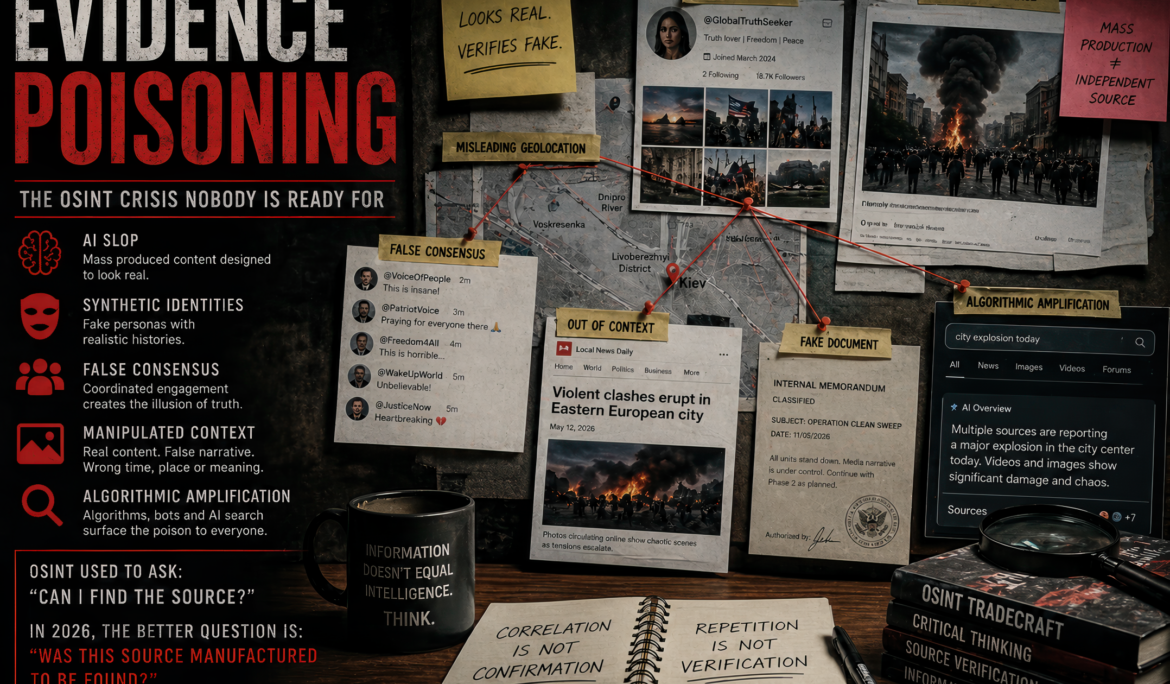
Evidence Poisoning: The OSINT Crisis Nobody Is Ready For
Over the past decade and a half, we have been confronted with chemical warfare, assassination operations involving nerve agents and lethal animal toxins, and accusations of illicit biological research activities, all indicative of serious breaches of the Chemical Weapons Convention (CWC) and the Biological and Toxin Weapons Convention (BTWC). The incidents were accompanied by information warfare, typically of the type in which one side claimed the allegations were fake and the other side argued their veracity. A characteristic of this information warfare is that the same antagonists – government outlets, organisations and institutions, individual scientists or academics, and motley groups …